



Gold Prizes Winner

Project Name:
Quick Sweep XI Cleanbot
Entrant Company:
Riverside Home Appliance Design Studio
Designer:
Sylvia Faulkner
Nancy Cissie
Category:
Product Design – Home Appliances
Client:
Northernice Cleaning Automation Co. Ltd.
Country / Region:
Canada

Follow the designers:
Facebook: https://www.facebook.com
X: https://x.com
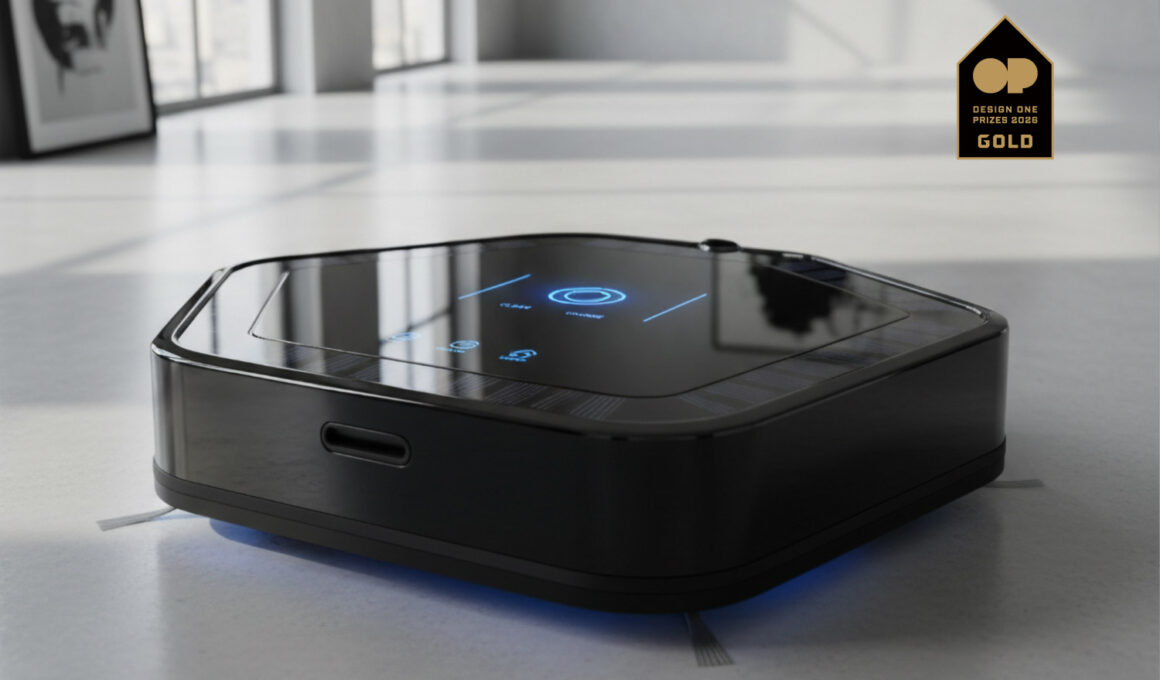
The “Quick Sweep XI Cleanbot” features a sleek and minimalist design, with a black color scheme and glossy finish that give it a modern look. It consists of two parts: the main cleaning unit and the docking station.
Appearance
The main cleaning unit is a discreet pentagon-shaped robot with a futuristic, stylish appearance. Its glossy black surface uses a piano lacquer finish made from nano-materials that help prevent dirt and bacteria from sticking. A prominent silver component on top houses the Laser Distance Sensor (LDS) used for navigation, enabling it to create a 360-degree map of the room. A small black bumper at the front helps absorb minor impacts during navigation.
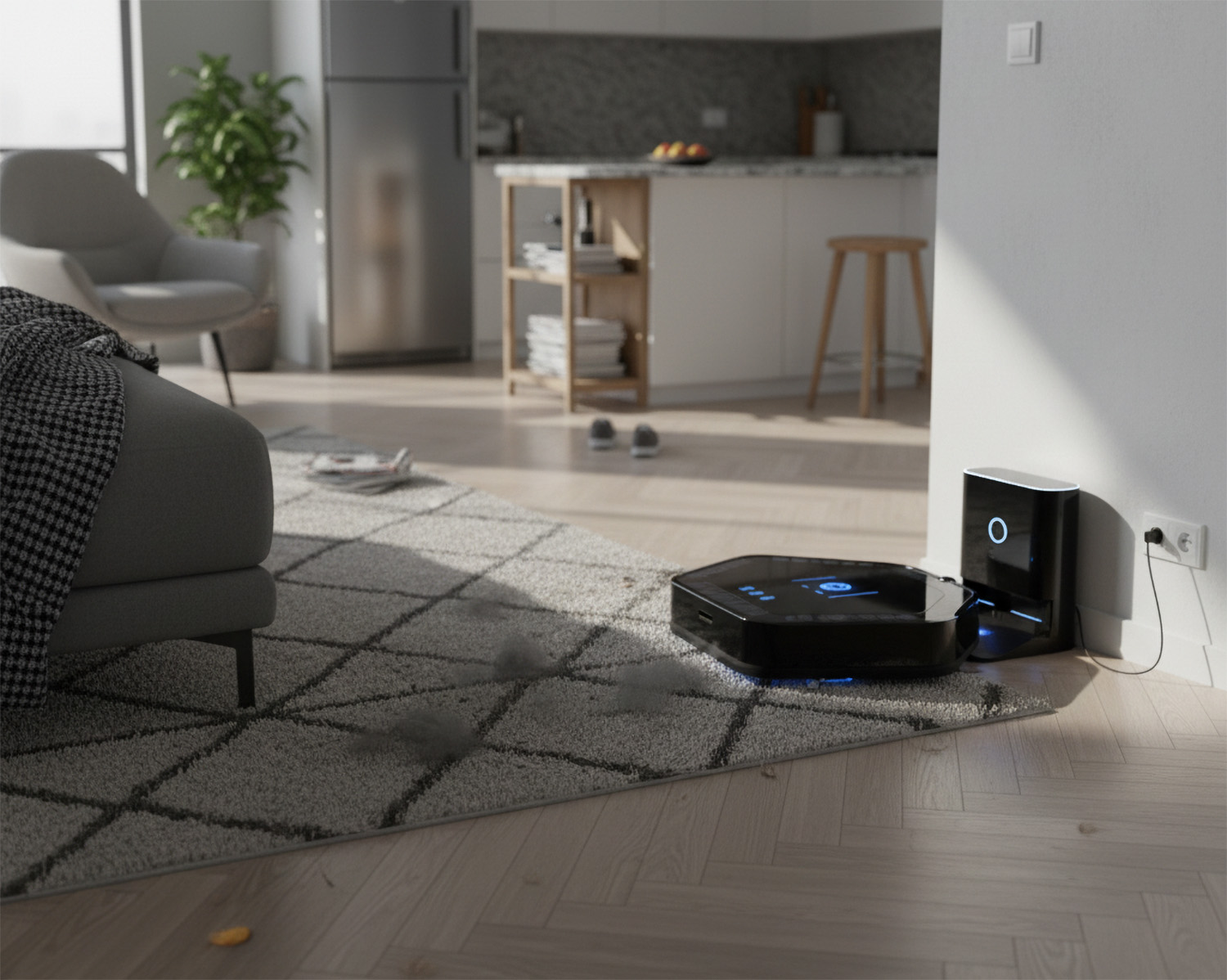
The docking station is a tall, rectangular tower with a slim profile and a matching glossy black finish. A round lid is located at the top. The station’s base features charging contact plates and a docking port for the vacuum. This large tower structure is a key indicator of its auto-emptying functionality.
This pentagonal multi-purpose robot vacuum has a stylish and technological look and a bright black piano lacquer finish.
Sylvia Faulkner and Nancy Cissie
Features and Functions
This robot vacuum combines several automated functions to provide a hands-free cleaning experience:
-
Vacuuming and Mopping: The device is a “two-in-one” unit capable of both vacuuming and mopping hard floors. An image shows a cloth-like pad attached to the bottom of the device for mopping. It also features a central roller brush and a smaller side brush to sweep debris into the main vacuum path.
-
Auto-Emptying: The most prominent feature is the auto-emptying docking station. When the robot’s internal dustbin is full, it automatically returns to its base. A powerful suction system within the station then pulls the collected debris from the robot’s dustbin into a larger, disposable dust bag or a reusable bin inside the tower. This significantly reduces the frequency of manual emptying, with the large-capacity bin holding weeks or even months of debris.
-
Navigation and Mapping: The circular protrusion on top of the robot likely houses a LiDAR (Light Detection and Ranging) sensor. This allows the vacuum to create a precise map of the house, enabling it to navigate systematically, avoid obstacles like furniture, and find its way back to the charging dock to recharge or empty its dustbin.


| Related Contributors | Name |
|---|---|
| Design Consultant | Walter Oscar |
| Material Engineer | Geoffrey Romeo |
| Assistant Designer | Quincy Harold |
| Sensing Component Manufacturers | C.D.L. Technology Co., Ltd. |